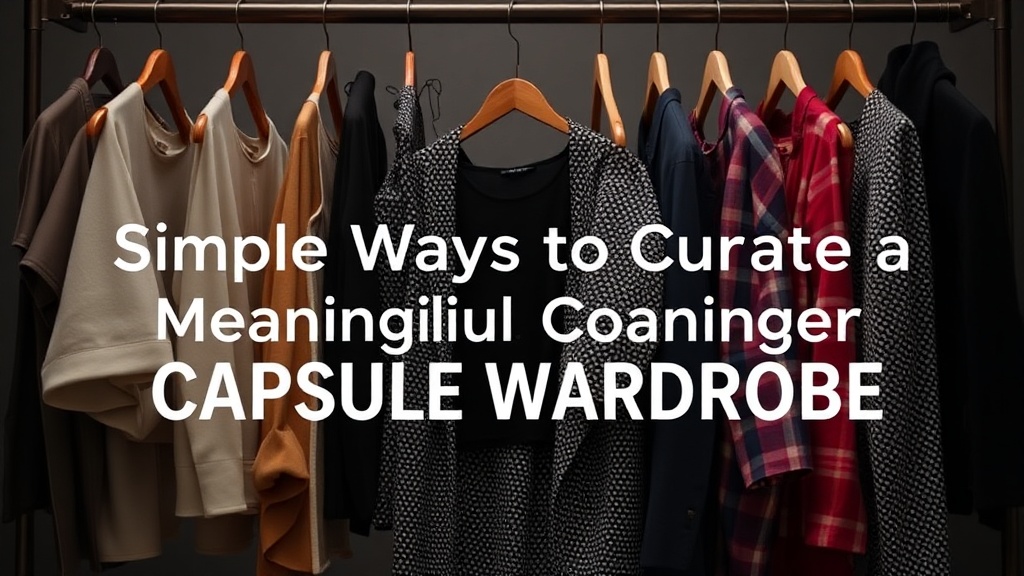
Simple Ways to Curate a Meaningful Capsule Wardrobe

Most people think building a capsule wardrobe requires a complete overhaul of your closet and a massive budget for high-end designer pieces. That's a mistake. A capsule wardrobe is actually about reducing decision fatigue and ensuring every single item you own serves a specific purpose. It’s a system designed to make getting dressed the easiest part of your day, not a chore that leaves you feeling frustrated.
This approach focuses on quality over quantity. Instead of a closet full of "maybe" clothes—the ones you only wear once a year or that don't actually fit right—you curate a collection of reliable, versatile pieces. We're looking at how to select fabrics, build color palettes, and maintain a rotation that works for your actual life, not an idealized version of it.
How Do I Start a Capsule Wardrobe?
Starting a capsule wardrobe begins with an honest audit of what you already own and what you actually wear. You can't build a new system without understanding the old one. Grab a pile of clothes and sort them into three categories: things you love and wear constantly, things that fit but are "just okay," and things you haven't touched in twelve months.
The goal isn't to throw everything away. It's to identify the common threads in your "love" pile. Do you gravitate toward cotton tees? Are you a fan of the structured look of a Levi's denim jacket? Once you see the patterns, you can shop with intent rather than impulse.
Here is a simple way to categorize your current items:
- The Staples: These are your workhorses. Think of a plain white tee, a reliable pair of black trousers, or a versatile trench coat.
- The Seasonal Pieces: Items that only work in specific weather, like a heavy wool coat or a linen sundress.
- The Outliers: These are the "fun" items—the bright patterns or trendy pieces that don't necessarily mix with everything else.
If you find yourself spending too much time deciding what to wear in the morning, it might be a sign that your morning routine needs more structure. I've written about building a productive morning routine, and reducing decision fatigue is a huge part of that.
What Is a Good Color Palette for a Capsule Wardrobe?
A successful capsule wardrobe relies on a cohesive color palette where most items can be mixed and matched effortlessly. A common mistake is choosing too many bright colors, which makes it impossible to pair items together. Instead, pick a base of neutrals and a few accent colors.
A standard, foolproof palette usually looks like this:
| Category | Example Colors | Function |
|---|---|---|
| Base Neutrals | Black, Navy, Camel, Cream | Provides the foundation for most outfits. |
| Accent Colors | Sage Green, Rust, Dusty Blue | Adds personality without clashing. |
| Texture/Pattern | Denim, Linen, Subtle Stripes | Adds depth to a monochromatic look. |
Think about your lifestyle. If you work in a corporate office, your neutrals might lean toward charcoal and navy. If you work from home or in a creative studio, you might lean into more earth tones or textures. The key is consistency. If you buy a bright yellow sweater, it should ideally work with at least three other items already in your closet.
Don't feel pressured to follow trends. A trend is a temporary distraction. A capsule wardrobe is a long-term investment in your personal style.
How Much Does a Capsule Wardrobe Cost?
The cost of a capsule wardrobe varies wildly depending on whether you are shopping for high-end luxury or budget-friendly basics. You don't need to spend thousands of dollars to have a functional closet. In fact, the most effective way to build one is often through a slow, intentional process of replacing worn-out items with better quality ones.
You can find high-quality basics at various price points. For instance, someone might invest in a high-performance outer layer like the Patagonia Nano Puff because it's durable and works across multiple seasons. Others might prefer the longevity of a classic piece from a brand like Everlane, which focuses on transparent pricing and sustainable materials.
The real "cost" is often the time spent researching. It’s easy to get caught in a cycle of buying cheap, fast-fashion items that fall apart after three washes. That's not a capsule wardrobe; that's just a cluttered closet. A single high-quality wool sweater is much better than five acrylic ones that lose their shape immediately.
If you're trying to save money, look at the cost-per-wear. A $100 pair of boots that you wear 200 times a year is significantly cheaper than a $30 pair of shoes that break after two months. It’s a shift in mindset from "how much is this?" to "how often will I actually use this?"
When you're shopping, keep these three rules in mind:
- Check the Fabric: Look for natural fibers like cotton, wool, silk, and linen. They breathe better and last longer.
- Check the Construction: Look at the seams and the weight of the fabric. If it feels flimsy or see-through in the store, it won't survive your washing machine.
- The "Three Outfit" Rule: Before buying anything, ask yourself if you can immediately think of three different ways to wear it with what you already own. If you can't, leave it on the rack.
It's also worth noting that a capsule wardrobe doesn't have to be a permanent state. You can have a "seasonal capsule." This means your summer wardrobe might be entirely different from your winter wardrobe, and that's perfectly okay. You're just swapping out the heavy knits for lighter linens.
A well-curated wardrobe actually gives you more freedom. It removes the anxiety of "having nothing to wear" despite a full closet. It allows you to show up as your most organized self. When your environment—including your physical belongings—is organized, it's much easier to maintain focus throughout the day.
Building this system takes time. It's a process of trial and error. You'll likely find that as you refine your collection, you actually buy less over time. You're no longer shopping for a "vibe" or a momentary impulse. You're shopping for a version of yourself that is prepared, intentional, and ready for whatever the day brings.